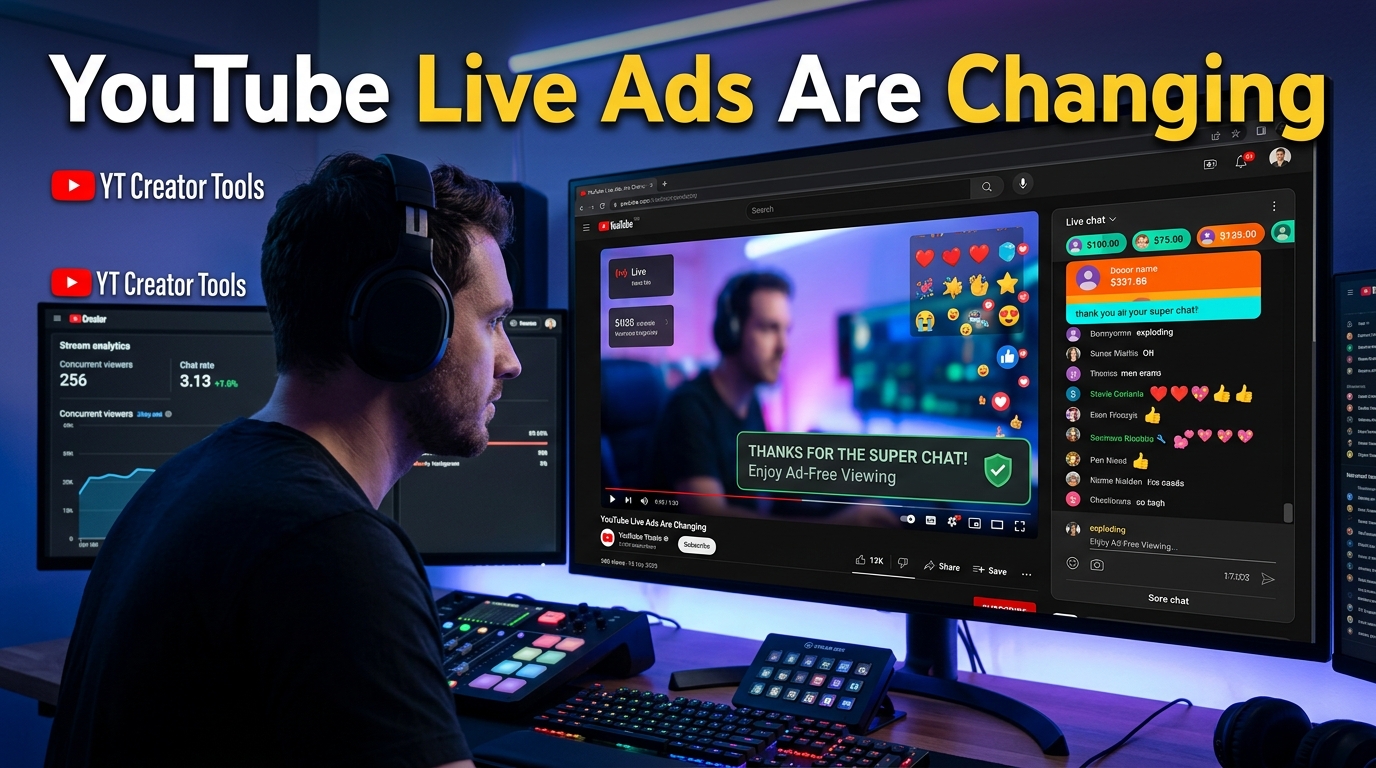
YouTube is quietly making one of its smartest live product moves in a while. Instead of treating ads on streams as a blunt monetization tool, the platform is starting to acknowledge something creators and viewers have felt for years - badly timed ads can damage the moment. And on live content, the moment is everything.
In its latest Live update, YouTube announced several changes that matter far beyond feature headlines. Viewers can now send gifts on horizontal live streams from mobile, fans who buy a Super Chat, Super Sticker, or gifts will get a personal ad-free window right after purchase, and YouTube says its system now recognizes when live chat engagement is peaking and automatically holds back ads for everyone during that stretch. This all points in the same direction: YouTube wants monetization on Live to feel less disruptive and less self-destructive.
What YouTube actually announced
According to YouTube’s April 13, 2026 Live update, viewers can now send gifts not only on vertical live streams, but also on horizontal live streams directly from their mobile devices. The company also said it is expanding gifts to more countries, including Canada, Korea, Indonesia, Thailand, Australia, and New Zealand.
But the more interesting part is what happens around ads. YouTube says that when a fan supports a creator with a Super Chat, Super Sticker, or gifts, the platform will roll out an automatic personal ad-free window right after the purchase. The idea is simple - if someone has just paid to participate in the moment, YouTube does not want that interaction immediately interrupted by an ad.
Why this matters more than it sounds
For years, one of the biggest frustrations with live monetization has been timing. Creators want revenue, but they do not want to crush momentum during the exact second their stream becomes exciting. A major reveal, a reaction, a heated debate in chat, a clutch gaming moment, a breaking update - those are the moments that build loyalty. They are also the worst moments to cut the emotional thread with an ad.
YouTube now appears to be admitting that openly. In the same update, the company says its system can recognize when Live Chat engagement is at its peak and automatically hold back ads for everyone, helping the community stay in the moment instead of being split by an interruption.
That is a bigger philosophical shift than it may first appear. It suggests YouTube is no longer treating live ads as just inventory to insert. It is starting to treat timing and viewer mood as part of the monetization logic.
What changes for viewers
From the audience side, the updates are easy to understand. Fans on mobile can now send gifts even on horizontal streams. Support moments after a purchase are less likely to be broken instantly by ads. And when chat is exploding, there is now a built-in chance the platform will avoid interrupting everyone at once.
That should make live viewing feel more coherent, especially on streams where community interaction is the real product. In practice, that could improve how premium moments feel, and it may also encourage more viewers to support creators if the system feels less annoying right after a purchase.
What changes for creators
For creators, the update matters on two levels. First, it opens another path for fan support by bringing gifts to horizontal mobile streams. Second, it lowers the risk that monetization itself kills the energy of the broadcast.
That does not mean creators suddenly stop caring about ad strategy. The new ad-free windows and chat-sensitive ad timing work only when automatic ads are enabled. So YouTube is also giving creators a quiet incentive: if you want the smarter ad behavior, you need to let the system manage part of the experience.
That will appeal to some creators and worry others. Some will welcome the automation because it reduces friction and protects momentum. Others will ask whether giving the platform more control over ad timing could reduce manual strategy or predictability.
YouTube is finally reacting to a real Live problem
The strongest angle here is not that YouTube added a few more monetization buttons. It is that the company is finally acting on a truth creators have been saying for a long time - aggressive ad interruptions during live streams can hurt retention, kill mood, and weaken the exact community feeling that makes live content powerful in the first place.
YouTube hinted at that direction earlier when it introduced side-by-side ads for Live as a less intrusive format. But this new update goes further by saying, in effect, that not every monetizable second should be monetized the same way. On Live, the emotional shape of the moment matters.
Why this could influence monetization strategy going forward
If these systems work well, creators may start rethinking how they approach live monetization entirely. Instead of seeing ads and fan support as competing forces, more channels may treat them as coordinated layers - ads handled more intelligently by the platform, and direct support designed to feel more rewarding and less frustrating for viewers.
That could be especially relevant for creators who already optimize the rest of their workflow with tools like a YouTube title generator, a YouTube description generator, a hook generator, or a script generator. The business side of Live is becoming more system-driven, not less.
The bigger takeaway
YouTube is not removing ads from Live. It is trying to make them less damaging. That distinction matters. The platform still wants creators to earn and still wants monetization to scale. But it now seems more willing to admit that retention, chat energy, and viewer mood are too valuable to ignore during key moments.
For viewers, that could make streams feel less broken. For creators, it could mean fewer painful trade-offs between earning money and preserving the vibe. And for YouTube itself, it is a sign that the company understands something very basic but very important - on live content, interruption is not just an ad issue. It is a trust issue.