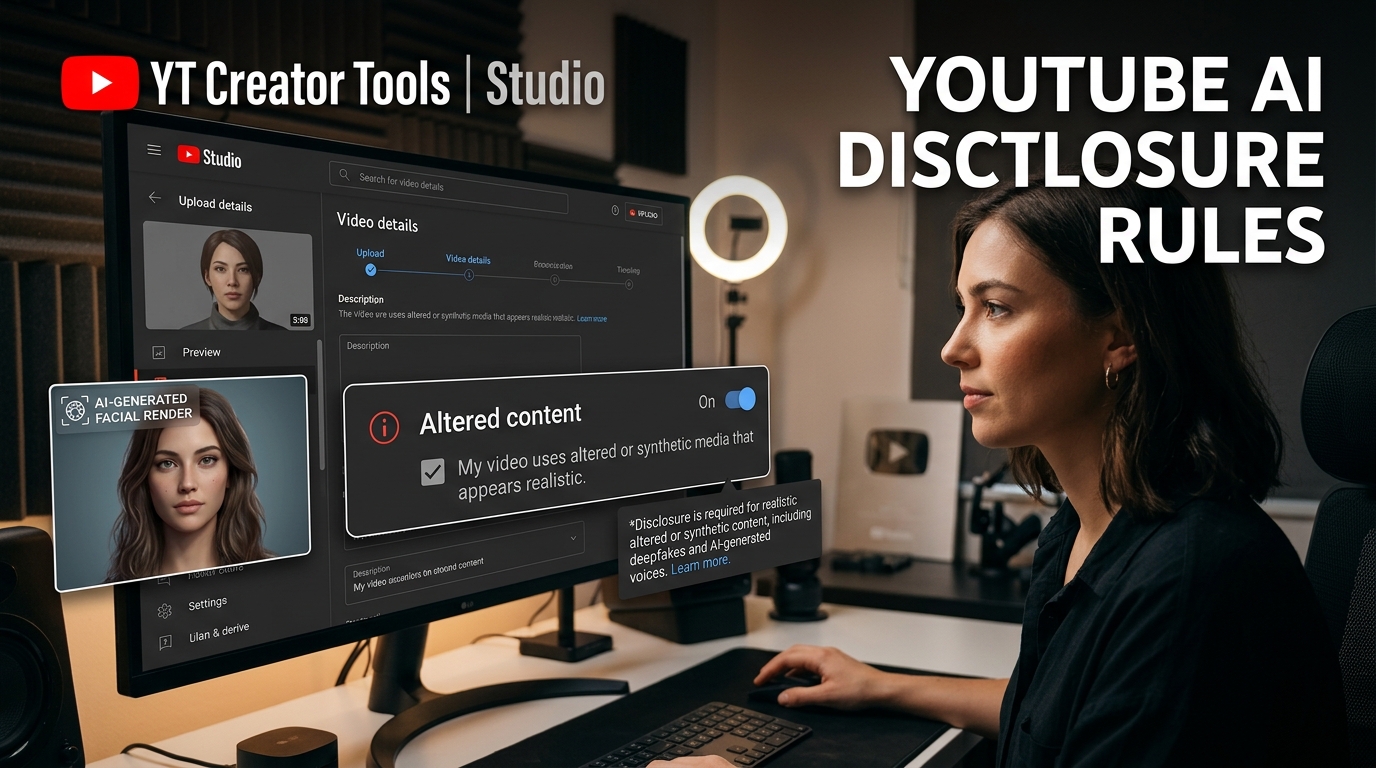
YouTube is making something very clear in 2026: AI disclosure is no longer a side issue for edge cases. It is becoming part of the normal publishing workflow for creators who use realistic altered or synthetic media. If a video could make viewers believe that a real person, place, event, or scene is authentic when it is not, YouTube expects creators to say so.
That matters because the platform is drawing a practical line between AI as a production helper and AI as a potentially misleading presentation layer. Script support, idea generation, thumbnails, captions, and repair tools are one thing. Realistic altered media that changes what viewers think they are seeing is something else.
What YouTube actually requires
YouTube says creators must disclose content that is meaningfully altered or synthetically generated when it seems realistic. The examples are very direct. If a real person appears to say or do something they did not do, if footage of a real place or event is altered, or if a realistic-looking scene is generated that did not actually happen, disclosure is required.
This is a very important distinction. The rule is not based on whether AI was used at all. It is based on whether the result is realistic enough, and meaningful enough, to mislead viewers about reality.
What does not require disclosure
YouTube also makes it clear that not all AI use needs a label. Unrealistic content does not require disclosure. Minor edits do not require disclosure. Production assistance does not require disclosure. That includes things like generating outlines, script ideas, thumbnails, captions, sharpening, upscaling, repair, and certain kinds of voice or audio cleanup.
That is useful because many creators were worried the platform might move toward labeling almost everything touched by AI. Instead, YouTube is focusing on realistic altered media, not on every tool-assisted workflow step behind the scenes.
What becomes automatic on YouTube
There is another important detail. YouTube says that if creators make a post or YouTube Short using one of YouTube’s own generative AI tools, they do not need to take extra steps to disclose. The platform will apply the disclosure automatically. For other AI tools, creators need to disclose through the upload flow.
That means the burden does not disappear, but it becomes split. If you use YouTube’s native generative tools, the platform handles the label. If you use outside AI tools, the responsibility still sits with you.
Why this matters to creators now
This is more than a transparency feature. It changes publishing discipline. A lot of creators now use AI-generated visuals, cloned voices, synthetic re-enactments, fake scenes, reconstructed interviews, deepfake-style experiments, and altered footage in ways that may look realistic to a casual viewer. The more common these workflows become, the more disclosure stops being optional culture and becomes baseline hygiene.
For creators who work with commentary, documentary style, celebrity topics, true crime, explainers, history reconstructions, parody news, or visual storytelling, this matters immediately. The closer the presentation gets to believable reality, the more important the disclosure decision becomes.
Why the line is actually useful
Some creators may see this as extra friction. In practice, it can also protect them. A clearer disclosure system gives creators a more defensible position when they are using synthetic media responsibly. It tells viewers that the creator is not trying to sneak a fabricated scene past them as truth.
That becomes especially important in sensitive areas like elections, conflicts, finance, health, public figures, and crisis-related content. YouTube says these categories may also receive more prominent labels in the player itself, not just in the expanded description, because the risk of real-world harm is higher.
Where creators can still get this wrong
The biggest mistake is assuming that because AI helped with only part of the video, no disclosure is needed. That logic can fail fast if the altered piece is the part viewers are most likely to believe. Another mistake is treating disclosure as something only for full deepfakes. YouTube’s examples show the rule is wider than that. It covers partial alteration too, as long as the result is realistic and meaningful.
Creators should also remember that disclosure and monetization are not the same thing. Marking altered content does not automatically solve every policy risk. It simply meets the transparency expectation around realism and synthetic manipulation.
What a safer workflow looks like
A stronger workflow now means asking a simple question before upload: could a normal viewer reasonably think this happened in real life if I do not explain it? If the answer is yes, disclosure is probably the safer path. That mindset is becoming part of creator professionalism, not just policy compliance.
For creators already tightening their workflow with better packaging and clearer publishing systems using tools like a YouTube title generator, a hook generator, a YouTube description generator, or a script generator, this is one more reminder that trust is now part of the production stack too.
Final take
YouTube is turning AI disclosure into a normal part of publishing because realistic synthetic media is no longer rare. It is everywhere, and the platform does not want viewers guessing what is real when the line is easy to blur.
For creators, the message is simple. You do not need to label every AI-assisted step. But if the final result could convincingly reshape reality in the viewer’s mind, disclosure is no longer something to debate casually. It is becoming standard practice.