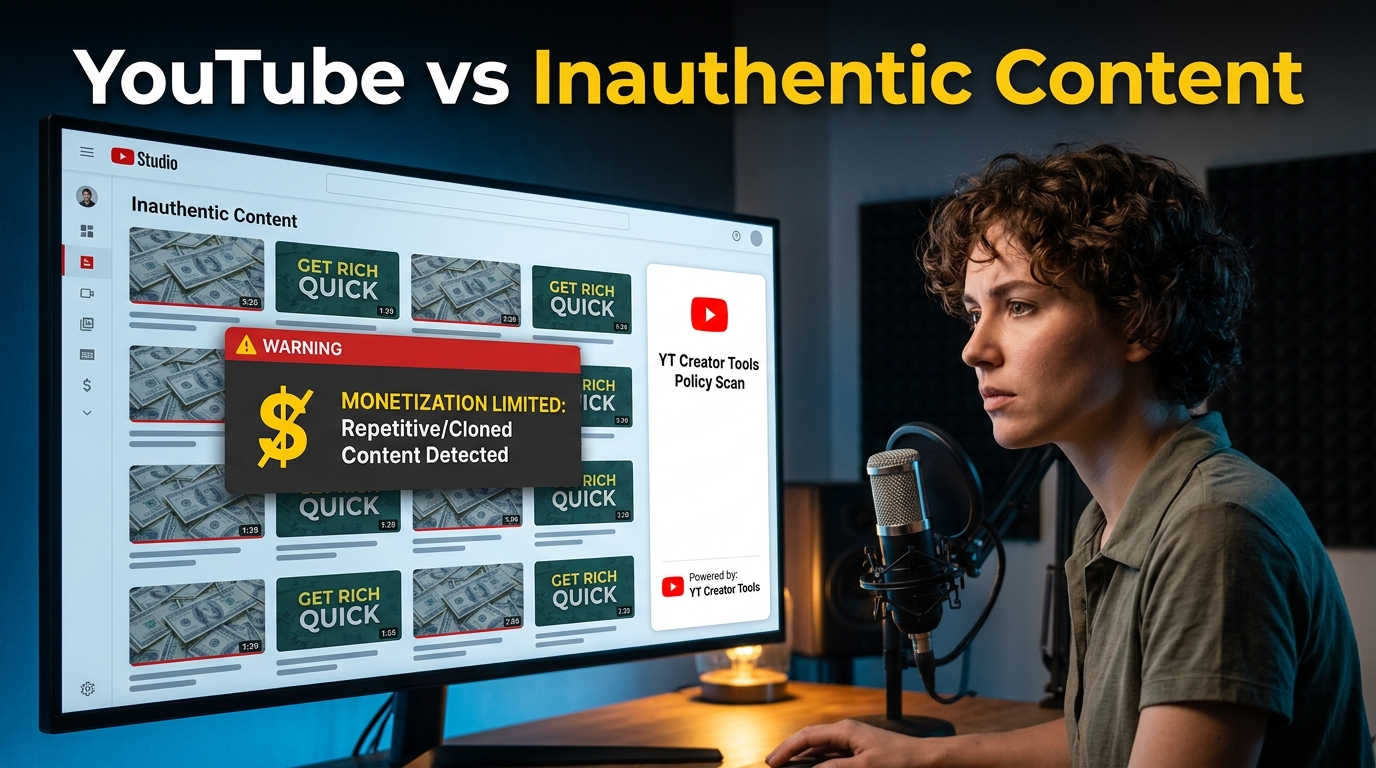
YouTube is sending one of its clearest signals yet about the kind of channels it does not want to reward with monetization. The platform has clarified that its old “repetitious content” language should be understood more directly as “inauthentic content” - in other words, repetitive or mass-produced material that lacks real originality. For creators building heavily automated, template-driven, or AI-assisted pipelines, that shift matters a lot.
Strictly speaking, YouTube says this is a clarification rather than a brand new crackdown. But in practice, language matters. When a platform stops describing a monetization risk as merely repetitive and starts framing it as inauthentic, it changes how creators hear the message. The issue is no longer just format fatigue. It becomes a question of whether the content feels genuinely original and meaningfully created at all.
What YouTube actually changed
YouTube says that on July 15, 2025 it made a minor update to its “repetitious content” policy to better clarify that this includes content that is repetitive or mass-produced. At the same time, it renamed the policy to “inauthentic content.” The company also says there was no change to its reused content policy, which still applies separately to commentary, clips, compilations, and reaction-style formats.
That distinction is important. YouTube is not saying all AI use, all formats, or all repeated structure is forbidden. It is saying that content built in a way that feels industrial, empty, or mechanically duplicated is not the kind of originality it wants to monetize.
Why this matters right now
A lot of creators are building faster than ever. AI tools can outline scripts, generate visuals, create voiceovers, repurpose scenes, and scale production far beyond what one person could do manually a few years ago. That creates opportunity, but it also creates a temptation to mass-produce near-identical videos with minimal real input.
And that is exactly where the risk lives. YouTube’s monetization system is not aimed at banning efficiency. It is aimed at filtering out channels that look less like creators and more like content factories.
What “inauthentic” really means in practice
The word itself matters because it points to the core issue more clearly than “repetitious” ever did. A channel can repeat a successful format and still feel authentic. Many good creators do that. The problem begins when the repetition becomes hollow - the same structure, the same delivery, the same pacing, the same script logic, the same visual flow, and the same value proposition over and over with almost no meaningful creative difference.
That is why the policy matters so much for AI-heavy workflows. AI can speed up research, generate ideas, help with drafts, assist thumbnails, and support localization. None of that automatically makes a channel unsafe for monetization. But if the final result feels like endless surface variation over the same empty template, YouTube is making it much clearer that this can become a monetization problem.
Why creators should not overreact either
There is an easy mistake here too. Some creators will hear this update and assume YouTube is coming after every AI-assisted channel. That is not what the official wording says. YouTube still allows many forms of original content that use tools, assistance, editing support, narration help, or structured repeatable formats. The platform’s issue is not with tools by themselves. Its issue is with low-effort sameness that tries to scale without enough genuine originality.
This means creators should focus less on whether they use AI at all and more on whether their content still clearly contains human editorial decisions, original framing, real value, and an identity viewers can feel.
How this hits different creator types
For channels built around commentary, education, reviews, storytelling, documentary structure, analysis, or personality-driven presentation, this update is mainly a warning not to let the workflow become too automated and empty. For channels built around mass-output listicles, generic narration, low-variation Shorts, endless slideshow clones, or spun scripts, the warning is much sharper.
If the audience cannot tell why one video exists instead of fifty nearly identical ones, YouTube may eventually start asking the same question in monetization review.
What a safer workflow looks like now
The strongest response is not panic. It is better process. Creators should make sure each video has a real editorial point, a distinct angle, a reason for its structure, and visible effort in how the information is framed. Repeating a format is fine. Replacing originality with volume is where the danger grows.
That also means the packaging layer still matters. A channel that already works carefully on hooks, titles, descriptions, and script logic with tools such as a YouTube title generator, a YouTube description generator, a hook generator, or a script generator should treat those tools as support, not as a substitute for point of view.
The deeper platform message
The deeper message from YouTube is that originality is becoming more important to prove, not less. As AI makes production easier, platforms need stronger language to separate efficient creation from empty duplication. Renaming the policy to inauthentic content is part of that shift. It tells creators that the platform is now thinking less about surface repetition and more about whether the content feels genuinely made.
Final take
YouTube’s stronger focus on inauthentic content is not a random wording tweak that creators can ignore. It is a practical warning that scale alone is not a defense anymore. If a channel grows by pumping out repetitive, mass-produced videos with minimal real distinction, monetization risk becomes easier to justify.
For serious creators, the lesson is simple. Use tools. Use AI. Build faster if it helps. But make sure the final video still feels like a real creative product, not just another unit rolling off a content conveyor belt.